Indonesian Rupiah at Record Low: What It Means for the Foreign Villa Investor in Lombok
The rupiah hits 17,668 per dollar in May 2026, MSCI removes six Indonesian stocks from its global index, and FDI keeps flowing into real estate. Analysis of how the currency asymmetry affects entry, income, and hedging for a European investor in Lombok villas.

The Signal
On Monday 18 May 2026, the Indonesian rupiah (IDR) was trading at 17,668 per US dollar, marking a new all-time low. Six days earlier, on 12 May, it had crossed the 17,500 threshold for the first time in history. Bank Indonesia, the central bank, has held its policy rate (BI Rate) at 4.75% for seven consecutive meetings and projects a rupiah target of 16,430-16,500 per dollar for the full year 2026, a figure that the market, as of this article, considers distant.
Adding to this currency pressure, MSCI's May rebalancing, announced 13 May and effective on 29 May, removes six Indonesian stocks from the MSCI Global Standard Index, including Amman Mineral, Chandra Asri Pacific and Barito Renewables. CGS International analysts estimate passive outflows of around USD 1.8 billion; broader market estimates put total foreign outflows from Indonesian equities at up to USD 10 billion.
And yet, first-quarter data published by the Ministry of Investment and Downstreaming (BKPM) tells a different story for the real-asset investor: total investment realization in Indonesia reached Rp 498.8 trillion in Q1 2026, up 7.2% year-on-year, with housing, industrial areas and offices accounting for 9.6% of that total, approximately Rp 48 trillion in three months.
This article analyzes what is happening with the currency, what it means for an investor evaluating a Lombok villa denominated in rupiah but paid in euros, and which risks should be modeled before any decision.
What Has Changed
Rupiah: Technical Break and Macro Context
The rupiah has lost roughly 3.2% against the dollar over the past month and 7.6% over the past twelve months. The EUR/IDR exchange rate stands at 20,516 on 18 May 2026, with the euro up 4.7% year-to-date against the rupiah.
The causes are a combination of external and internal factors:
- Geopolitical tension and oil prices: the deadlock in US-Iran negotiations keeps crude prices elevated, putting pressure on emerging Asian currencies that are net energy importers
- Emerging market risk aversion: dollar strength and investor caution on the US rate cycle drains capital from frontier and emerging markets
- Composition of domestic growth: Q1 2026 GDP growth of 5.61% came mostly from government spending and consumption rather than private investment, limiting the currency-strengthening effect
- MSCI rebalancing: the early removal of six large-cap stocks from the global index generates passive selling that reduces FX inflows via the equity channel
MSCI: Portfolio Rotation, Not Productive Capital Exit
The May rebalancing has a clear technical effect on the liquidity and price of the six affected stocks (Amman Mineral, Chandra Asri Pacific, Dian Swastatika Sentosa, Petrindo Jaya Kreasi, Barito Renewables Energy, Sumber Alfaria Trijaya). The IHSG, the Jakarta Stock Exchange's benchmark index, closed the announcement day down 1.2%-1.3% depending on the trading session.
The relevant interpretation for the real-estate investor is not the IHSG drop. It is the distinct nature of the two flows:
- The passive capital exiting via MSCI rebalancing is portfolio capital, liquid, sensitive to rate cycles and index composition
- The capital flowing into housing and industry via BKPM is FDI, long-horizon, committed to physical projects on the ground
FDI Composition: Singapore Leads, Property and Services Grow
In Q1 2026, Singapore was the leading source of FDI with USD 4.6 billion, followed by Hong Kong (2.7), China (2.2), the United States (1.3) and Japan (1.0). The heaviest sub-categories were basic metals (13.9%), other services including data centers (12.9%), mining (10.4%), housing and industrial areas (9.6%) and transport and telecommunications (9.1%).
For the investment-villa segment, the relevant data point is not the country-of-origin ranking but the fact that the housing category maintains a double-digit share in a quarter where the equity market sentiment was clearly negative.
What It Means for the Foreign Villa Investor
Entry Asymmetry: The Euro Buys More Square Meters
A Lombok villa whose price in rupiah stays constant between January and May 2026 today costs the European investor 4.7% less in euros than at the beginning of the year. For a one-bedroom villa with an entry ticket of EUR 104,000, the rupiah equivalence implies an implicit discount versus the local-currency price that European demand has not yet capitalized.
This asymmetry is not eternal. Three factors can close it:
- Rupiah appreciation if Bank Indonesia interventions and a potential BI Rate cut toward late 2026 stabilize the exchange
- Upward price adjustment in local currency from developers who partially index to USD/EUR costs (imported materials, international architecture fees)
- Local inflation that erodes IDR purchasing power but does not necessarily restore purchasing power for the EUR investor
Income Translation: The Other Side of the Trade
A villa generating gross income of Rp 800 million per year at 80% occupancy receives that income in local currency. If the operator converts to euros for distribution to the owner and the rupiah has depreciated 7.6% over twelve months, the investor receives fewer euros for the same gross IDR flow.
There are three operational mitigants:
- Partial ADR indexation to hard currencies: in the premium segment with international guests (Australia, Europe, Singapore), OTA platforms display price in the guest's currency, which tends to push ADR in IDR up when the local currency weakens
- Operating costs in IDR: management, maintenance, supplies and payroll are paid in rupiah, so the FX pressure on the investor mainly affects the converted net margin, not the gross operating margin
- Local reinvestment: an owner who does not need immediate cash flow can reinvest IDR distributions inside the country (capex improvements, a second project, 5%-6% term deposits), avoiding crystallizing the conversion at the worst rate
Hedging: How Much Is It Actually Worth
A pure FX hedge on an illiquid real estate position is expensive and rarely optimal. A 12-month EUR/IDR forward trades with a positive spread reflecting the rate differential between the BI Rate (4.75%) and the EUR (ECB around 2%-2.25%), which makes hedging income flow costly. Hedging the asset value is structurally unfeasible in frontier markets.
The more efficient approach used by experienced investors in emerging real assets combines three elements: a tranched entry structure to average the exchange rate, retention of a percentage of operating flow in local currency for reinvestment, and a financial model stressed to weak-IDR (17,500-18,000) and strong-IDR (15,500-16,500) scenarios to bound the IRR range.
Lombok in This Context
Lombok offers entry tickets between EUR 67,000 and EUR 250,000 for premium product with professional management. Compared with Bali or Phuket, the combination of lower price per square meter and net yield in the 7%-14% range leaves more cushion to absorb FX volatility without compromising the target IRR. The PT PMA tax regime with PPh Final 0.5% for the first three years, plus the option to reinvest locally in other developer assets, are additional levers to mitigate currency friction.
An investor who has been waiting for a strategic "entry point" now finds a historically weak rupiah, expanding air infrastructure, and a confirmed premium hospitality pipeline. It is not a guarantee of return; it is a set of conditions worth modeling honestly.
The yield ranges, exchange rates and scenarios mentioned are based on public data as of 18 May 2026 (Bank Indonesia, BKPM, Bloomberg, Reuters, MSCI). They do not constitute financial, tax or legal advice. All real estate investment carries market, currency, regulatory and operational risk; actual results may differ from projections. Any decision requires project-specific due diligence and consultation with professional advisors.
Frequently Asked Questions
Is the rupiah "broken" or is this a normal cycle? The recent depreciation is significant but not unprecedented in the rupiah's recent history (similar lows were seen during the 1998 Asian financial crisis and in episodic 2018-2020 stretches when adjusted for inflation). Bank Indonesia holds international reserves above USD 150 billion and active intervention tools. Analyst consensus expects stabilization in the 16,500-17,500 range by late 2026.
Should I wait for further weakening before entering? Trying to time the bottom of an emerging-market currency with an illiquid real estate asset has a high opportunity cost. If a villa takes twelve months between commitment and delivery, the FX window captured is the one at payment time, not at announcement time. The strategy most used by institutional investors is to define the allocation first and average entries across two or three tranches.
Should I finance the purchase locally in rupiah? Rarely. Mortgage rates for residential property in Indonesia sit above 8% for non-residents, compared with 3%-4% available in European markets on internationally collateralized loans. Local financing only makes sense when there is a natural hedge from comparable IDR income.
What is the impact of the MSCI exit on real estate? Minimal and largely psychological. The six affected stocks belong to unrelated sectors (mining, chemicals, renewable energy, retail). Productive FDI in housing maintains its share.
Risks and Caveats
Any investor considering positioning in Lombok partly on the basis of this currency dynamic should consider:
- Risk of further FX weakening: the rupiah may keep weakening if geopolitical tension persists, if the US rate cycle stays restrictive longer than discounted, or if Bank Indonesia interventions run out of ammunition without stabilizing the rate. IDR scenarios of 18,000-19,000 per dollar are possible, though not central.
- Local inflation risk: a weak rupiah pressures imported inflation (construction materials, electronics, fuel) and may force Bank Indonesia to raise rates rather than cut, raising domestic financing costs and compressing developer operating margins.
- Asymmetric hedging risk: financial hedging via forward or NDF has explicit cost (cost-of-carry) that reduces net yield. A poorly calibrated hedge can destroy more return than it protects.
- FX regulatory risk: Indonesia has partial controls on capital repatriation and documentation requirements on source of funds (KYC, anti-money-laundering, banking reporting). An investor who does not properly document the capital inflow may face friction on exit.
- Tourism correlation risk: if a weak rupiah is accompanied by political instability or exogenous events affecting safety perception, occupancy may drop and erase the nominal benefit of the FX move on IDR-denominated income.
What to Read Next
- Lombok rental yield analysis 2026: breakdown of ADR, occupancy and net yield by typology in local currency
- European investor guide to Lombok villas: taxation, PT PMA structure and FX considerations for EU residents
- Indonesia Golden Visa for property investors 2026: the other side of the Indonesian offer to HNWIs
Sources Consulted
- Bank Indonesia, monetary policy statement (May 2026) and 2026 macroeconomic projections
- Tempo, "Expert Shares Why Rupiah Falls Below Rp17,500 per US Dollar Today" (12 May 2026)
- The Star Malaysia, "Indonesian rupiah falls below 17500 per dollar on US-Iran deadlock" (12 May 2026)
- Bloomberg, "IDR/USD: Indonesia Pledges Smart Interventions as Rupiah at Record Low" (13 May 2026)
- Asia Times, "How low will Indonesia's falling rupiah go" (May 2026)
- The Diplomat, "Why the Rupiah is Weakening" (May 2026)
- Jakarta Globe, "Indonesian Stocks Sink as Rupiah Hits Rp 17,505 Ahead of MSCI Review"
- BKPM / Kementerian Investasi, Q1 2026 investment realization release
- Databoks Katadata, "Singapore the Largest Foreign Investor in Indonesia Q1 2026"
- MSCI, May 2026 index review announcement (effective 29 May)
- European Central Bank, EUR/IDR reference rate (May 2026)
- Trading Economics, Indonesia Interest Rate (BI Rate 4.75%)
- IDN Financials, "BI Governor Perry Warjiyo: Rupiah target next year at IDR 16,500/USD"
Lombok International Development is a developer specialized in villas and integrated projects in Lombok, Indonesia. We operate under a PT PMA structure with full regulatory compliance. For a specific conversation on investment strategy and FX modeling, contact us.
CONTINUE READING
Related Articles
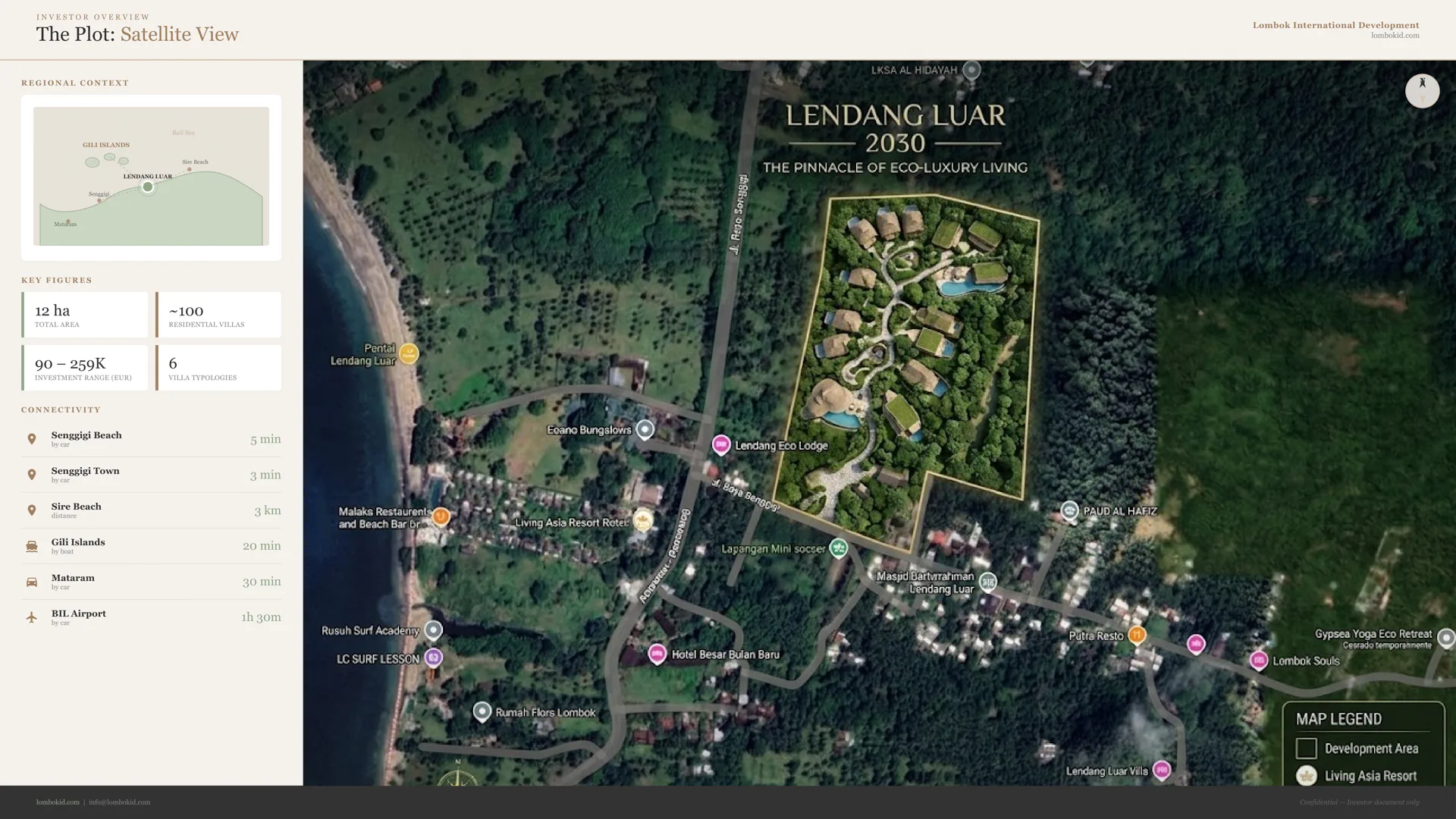
Lombok-Australia Direct: Why the New Air Route Matters for Your Investment
TransNusa opens the first direct Darwin-Lombok flight in February 2026. Perth, Kuala Lumpur, and Singapore follow. Analysis of what expanded air connectivity means for yields, occupancy, and the investor market.
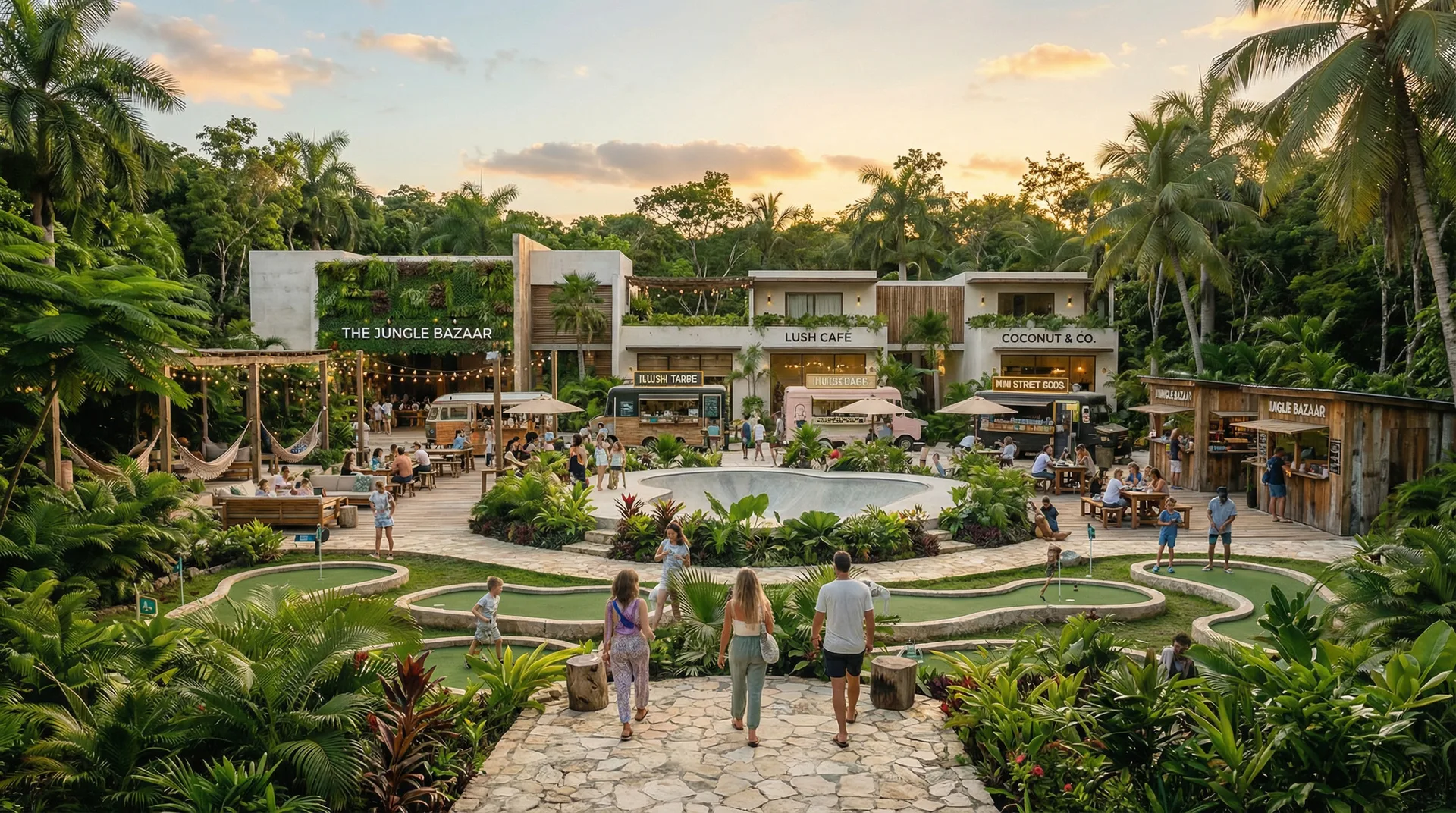
Lombok 2026: The Infrastructure Boom Behind the Investment Case
USD 3 billion in government infrastructure, MotoGP, airport expansion, and 25% tourism growth. Why Lombok's investment window is driven by concrete catalysts, not speculation.

West Lombok: The Emerging Frontier of Real Estate Investment
Why West Lombok is outpacing South Lombok and Bali as an investment destination. Infrastructure, Sire Beach, Lendang Luar 2030, and land prices compared.
INVESTOR DOSSIER
Want the full picture on Lombok?
Receive the investor dossier with current pricing, legal structure and a five-year projection tailored to your profile.