Lombok-Australia Direct: Why the New Air Route Matters for Your Investment
TransNusa opens the first direct Darwin-Lombok flight in February 2026. Perth, Kuala Lumpur, and Singapore follow. Analysis of what expanded air connectivity means for yields, occupancy, and the investor market.
The Signal
On 24 February 2026, a 95-seat Comac C909 operated by TransNusa took off from Darwin bound for Lombok International Airport. Two hours of flight time. Four weekly frequencies. For the first time in history, Australia has a direct air link with Lombok without routing through Bali. The airline has also confirmed planned routes to Perth, Kuala Lumpur, and Singapore during 2026.
The single data point does not look transformative on its own. Four weekly flights do not move a market. But read in the right context, Lombok airport scaling toward 7 million passengers annually in 2026, the Mandalika Special Economic Zone expanding, Hyatt's confirmed arrival with Samara Lombok, and an official forecast of 2.8 million visitors to Lombok in 2026, the TransNusa launch functions as a leading indicator of something broader: Lombok is stepping out of Bali's overflow traffic and building its own demand corridor.
This article explains what has changed in air connectivity, what it means for an investor evaluating a Lombok villa, and which risks should not be ignored.
What Has Changed
TransNusa Darwin-Lombok: First Milestone
TransNusa, an Indonesian regional airline based in Jakarta, officially launched the Darwin-Lombok route on 24 February 2026, confirmed by the carrier and covered by Australian aviation media. The initial schedule is four weekly frequencies on Comac C909 aircraft with 95 seats. Flight time is approximately two hours, placing Lombok closer to Darwin than many Australian domestic destinations.
The company has communicated plans for three additional international routes during 2026:
- Lombok-Perth: targeted for the second half of 2026, connecting directly with Western Australia
- Lombok-Kuala Lumpur: planned for 2026, opening the Malaysian market without a transfer
- Lombok-Singapore: planned for 2026, a key link with Southeast Asia's primary financial hub
Airport Capacity: A Step Change
LOP already received substantial expansions in 2022 (terminal and runway) and 2024 (waiting lounges: domestic capacity at 1,600 seats and international at 1,200 seats) to support the MotoGP editions. The official roadmap targets LOP handling up to 7 million passengers annually in 2026, with direct connections confirmed or planned to Perth, Singapore, and Kuala Lumpur.
As of May 2026, 11 airlines operate from LOP to 26 airports. The relevant benchmark is Bali (Ngurah Rai): close to 25 million passengers annually in 2024. Lombok is not aiming to match Bali in the short term, but moving from marginal traffic to 7 million passengers with its own international network is a category shift, not an incremental one.
Mandalika and the Supporting Economy
The aviation expansion does not occur in isolation. The Mandalika Special Economic Zone, operated by the state-owned ITDC, has attracted more than USD 3 billion in committed and planned investment across hospitality, infrastructure, and sustainable real estate. The hotel pipeline includes Pullman, Club Med, Royal Tulip, Marriott, and InterContinental, plus the integrated Samara Lombok development that Hyatt signed in 2025 to operate under its Destination by Hyatt brand (phased opening from 2026, full completion expected between 2027 and 2028).
Separately, PT Kleo Mandalika Resort has committed roughly Rp 2.1 trillion (USD 130 million) for a five-star hotel on Tanjung Aan beach within the SEZ.
The combination matters because a Lombok villa investor does not compete with these hotels, they benefit from them. Every five-star hotel room that opens creates induced demand for premium accommodation with private kitchens, privacy, and the villa format that a hotel does not cover.
Tourist Arrivals: The Underlying Curve
Lombok closed 2024 with approximately 1.2 million total visitors, a 51.4% year-over-year growth according to sector media compilations. In the first four months of 2025, official records showed cumulative growth above 77% across the three main regencies (North Lombok, Central Lombok, West Lombok). For 2026, the Indonesian Ministry of Tourism (Kemenparekraf) has set a target of 2.8 million visitors to Lombok.
A government target is not an audited forecast. But the convergence of air capacity, hotel infrastructure, and internationally visible events (MotoGP Mandalika closed 2025 with a record 142,000 spectators and an estimated economic impact of Rp 4.8 trillion) makes the range defensible.
Visitor, occupancy, and yield estimates cited in this article come from public official and private sources. Actual results may vary depending on macroeconomic, regulatory, operational, and climate factors. All real estate investment carries risk; no return outcome is assured.
What It Means for a Villa Investor
Source Market: Real Diversification
Until 2025, an investor modeling occupancy for a Lombok villa was implicitly assuming dependence on the European corridor (via Singapore or Doha) and the Indonesian domestic market. The new routes change that origin composition:
- Australia has historically been one of the top three source markets into Indonesia (after Singapore and Malaysia)
- Perth and Darwin combined provide a population base with high disposable income and a documented propensity for surf, retreat, and wellness travel
- Kuala Lumpur opens the Malaysian corridor and connecting traffic from the Middle East
- Singapore consolidates financial and corporate flow
ADR and RevPAR: Realistic Effect, Not Inflated
The fair question is whether more air capacity translates automatically into higher ADR or higher occupancy. The honest answer is: not linearly.
More air supply from mid-to-high income markets tends to push ADR when it arrives alongside premium inventory (which the Mandalika SEZ is building). If air capacity grew without new upscale hotel supply, the effect would be more volume but flat or declining ADR.
The current scenario combines both dynamics: more air capacity plus more premium hotel capacity. The reasonable expectation is that ADR for premium villas with good location and professional management stays stable or grows moderately, while occupancy gains points over the 2024-2025 base.
The net yield ranges we use for Lombok villas (on the order of 7-14% depending on typology, management, and tax regime) already start from conservative assumptions. The new air flow reinforces the thesis without forcing an upward model revision.
Competitive Window: Lombok vs. Bali
Bali is going through a documented saturation in the short-stay rental segment. The provincial government has set 31 March 2026 as the regulatory compliance deadline (Pondok Wisata or TDUP licence, tax registration, correct NIB and KBLI) for properties marketed via OTAs, with risk of removal from Airbnb and Booking if they do not comply. More than 39,000 Bali listings are estimated to be affected.
That temporal overlap, Bali in regulatory consolidation, Lombok in demand expansion, defines the competitive window. This is not a promotional claim: it is the reasonable reading of the moment. An investor entering Lombok now positions themselves in a market with cleaner regulation from inception, less saturation, and a demand curve supported by concrete catalysts.
The Lombok International Development Angle
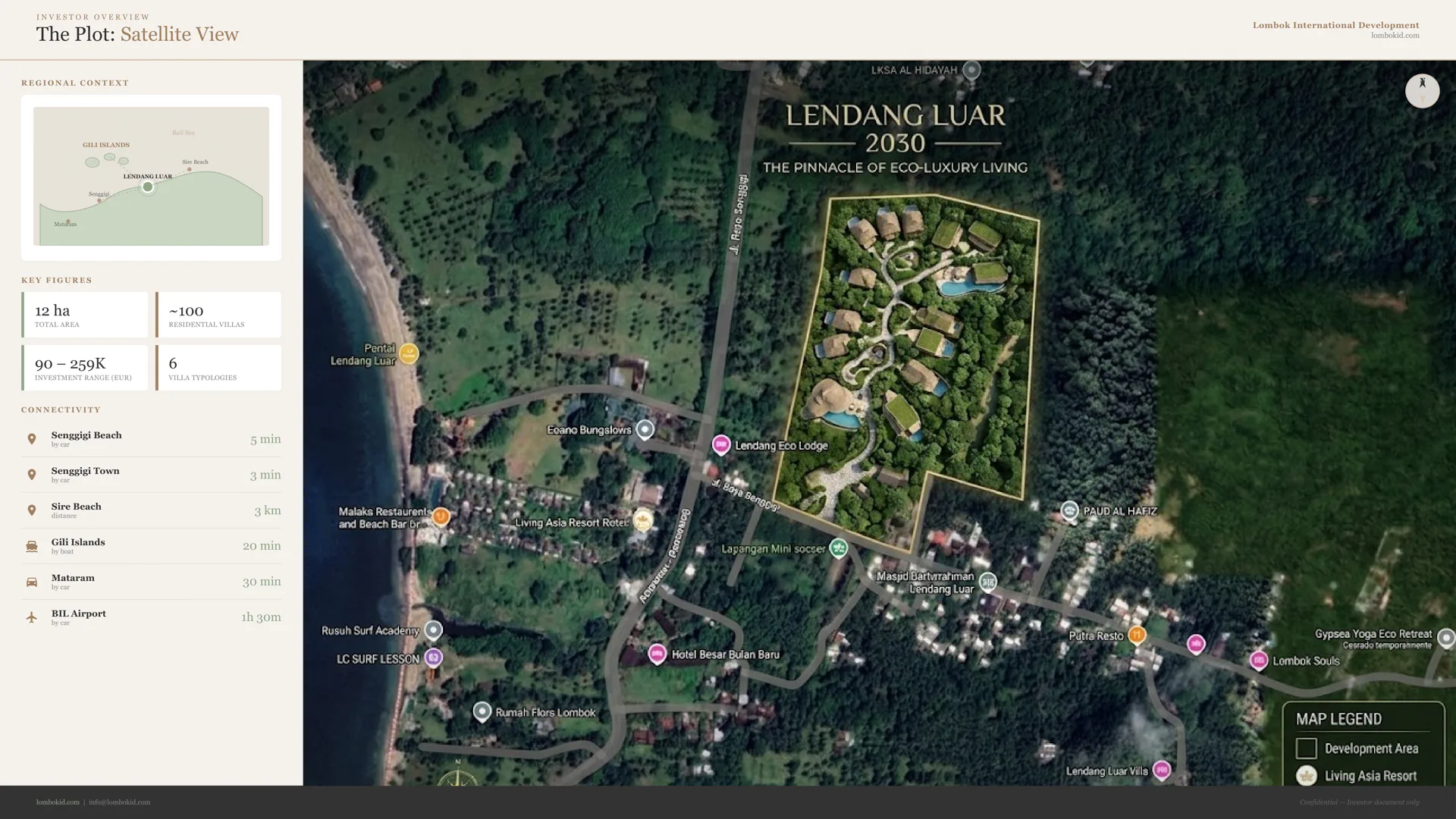
We designed our Lombok developments assuming connectivity would improve, not waiting for it to improve. The location of Lendang Luar 2030 in West Lombok was chosen in part for its access to the airport (via the Mandalika road network) and to the northwest coastline, where the rise in air traffic generates demand without the tourist overpopulation of Bali.
Our financial models are built on conservative occupancy and ADR ranges, not on the optimistic 2.8 million visitor scenario. When the actual curve approaches the target, the investor captures the upside; when it falls short, the model holds. That is the discipline a professional investor needs and what our documentation delivers.
FAQ
When did the Darwin-Lombok route actually start? TransNusa launched it on 24 February 2026 with four weekly frequencies. The route is operated by 95-seat Comac C909 aircraft. The company has confirmed its intention to also operate Lombok-Perth, Lombok-Kuala Lumpur, and Lombok-Singapore during 2026.
How long until Lombok airport is ready for 7 million passengers? Nominal capacity is targeted for 2026 according to official communications from the airport operator and Kemenparekraf. The physical expansions (terminal, runway, waiting lounges) were completed between 2022 and 2024. What scales now is the route network and operations.
Do these new routes justify buying a villa today? The new routes are one of several catalysts, not the only one. An investment decision must be based on the specific villa's financial model (entry price, yield, operating costs, PT PMA tax framework, professional management) and the investor's risk tolerance. Air connectivity is a demand-side input, not a return assurance.
What if TransNusa cancels a route? It is a real risk. New routes often go through early phases with low load factors. If frequencies are reduced or cancelled, the Australian source market would take longer to consolidate. However, the aggregate trend (other airlines watching the corridor, Mandalika SEZ attracting capital) defines the thesis, not a single operator.
Risks and Caveats
Any investor considering positioning in Lombok partly based on this connectivity evolution should weigh:
- New-airline operational risk: TransNusa is a regional operator with a limited fleet. Cancellations, frequency reductions, or technical issues with Comac C909 aircraft (relatively new in international service) could delay consolidation of the Australian corridor.
- Macro and currency risk: the Indonesian rupiah (IDR) has significant historical volatility against EUR and USD. Strong depreciation improves ADR in local terms but can affect imported construction costs and the translation of yields into the investor's currency.
- Regulatory risk: the Indonesian framework for foreign investment (BKPM, Hak Pakai, PT PMA) has been relatively stable but is subject to change. Short-stay rental compliance (NIB, KBLI, tax registration) is now enforceable and increases operating costs if not managed from day one.
- Hotel oversupply risk: the Mandalika pipeline contemplates more than 20,000 rooms over the medium term. If supply grows faster than demand in the mid-to-upper segment, there could be transitory ADR compression. The premium villa segment is more resilient but not immune.
- Climate and event risk: Lombok sits in an active seismic zone (2018 earthquake). Construction must follow rigorous seismic standards, and property insurance is a non-negotiable operating cost.
Projections, yield ranges, and scenarios mentioned in this article are based on public data and internal analysis as of May 2026. They do not constitute financial, tax, or legal advice. Any investment decision should be made after project-specific due diligence and consultation with professional advisors.
Further Reading
- Lombok 2026: The Infrastructure Boom Behind the Investment Case: macro view of the USD 3 billion infrastructure pipeline
- Lombok Rental Yield Analysis 2026: detailed breakdown of ADR, occupancy, and net yield by typology
- Compliance for Villas in Indonesia 2026: what the short-stay rental regime requires and how it impacts the model
Sources Consulted
- TransNusa, official communication on Darwin-Lombok launch (February 2026)
- Travel and Tour World, "Darwin and Lombok Gain Direct Flights via TransNusa in 2026"
- Karry On Australia, international aviation coverage 2026
- Jawawa.id, "TransNusa Airlines Launches Darwin-Lombok Flight Service"
- Time Out Australia, "All the new international flight routes taking off from Australia in 2026"
- Eastern Edge, MotoGP Mandalika 2025 data (142,000 spectators, Rp 4.8 trillion impact)
- Discover Lombok Guide, Mandalika SEZ 2026 hotel pipeline
- Hyatt Newsroom, Samara Lombok announcement (29 May 2025)
- ITDC (Indonesia Tourism Development Corporation), Mandalika portfolio
- BKPM / Kementerian Investasi, PT PMA and OSS regulation 2026
- BPS West Nusa Tenggara, official provincial tourism statistics
- Kemenparekraf, Lombok tourism targets 2026
Lombok International Development is a developer specializing in villas and integrated projects in Lombok, Indonesia. We operate under a fully compliant PT PMA structure. For a specific conversation about investment strategy, contact us.
CONTINUE READING
Related Articles
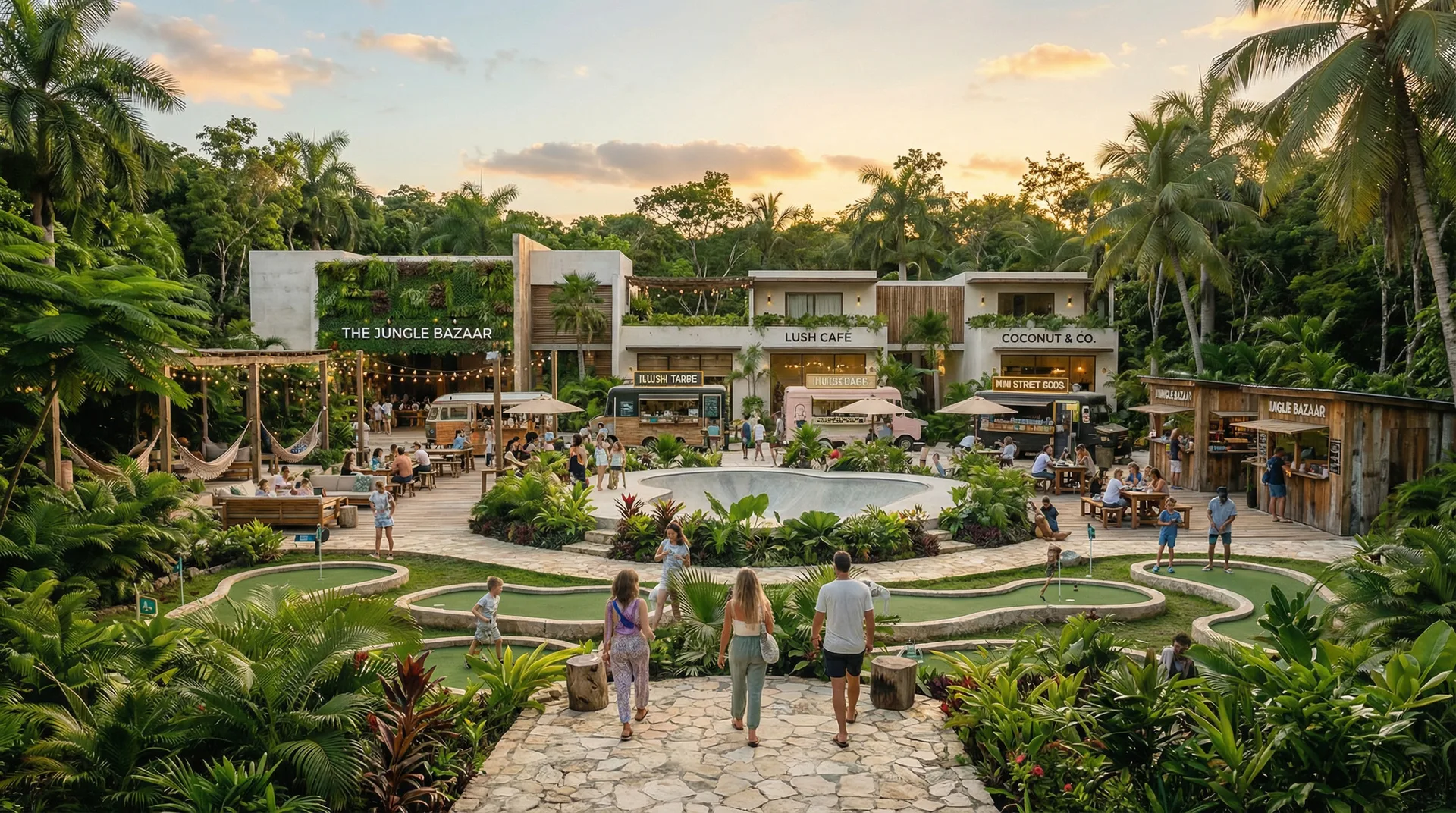
Lombok 2026: The Infrastructure Boom Behind the Investment Case
USD 3 billion in government infrastructure, MotoGP, airport expansion, and 25% tourism growth. Why Lombok's investment window is driven by concrete catalysts, not speculation.
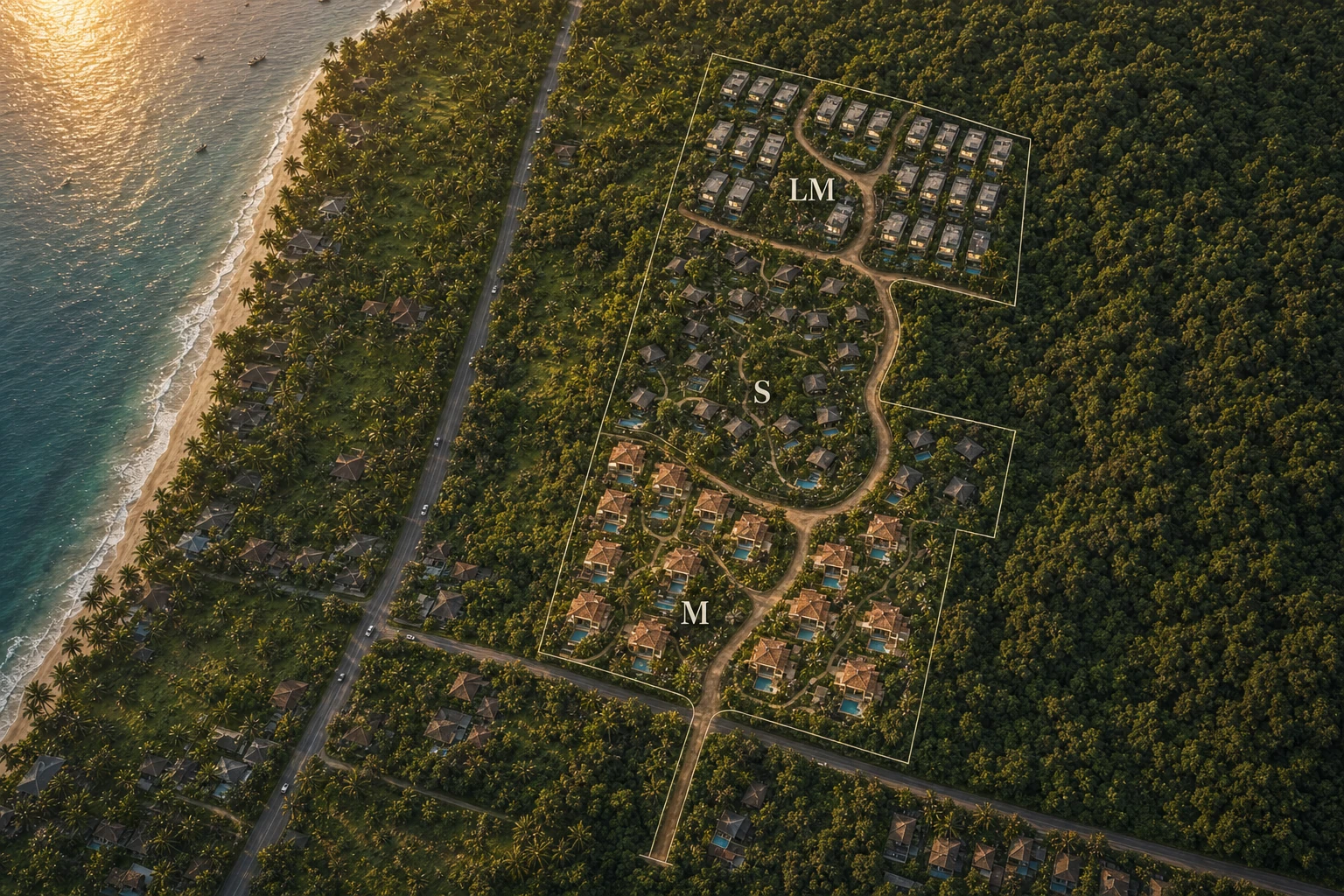
MotoGP Mandalika 2026: How the October Calendar Affects the Financial Model of a Lombok Villa
Indonesia's Grand Prix returns to the Mandalika circuit on 9-11 October 2026 after a 2025 edition with 142,000 spectators, Rp 4.8 trillion in economic impact, and 100% hotel occupancy across the SEZ. Analysis of what the anchor event means for ADR, occupancy, and the capex calendar of a Lombok villa investor.

Indonesian Rupiah at Record Low: What It Means for the Foreign Villa Investor in Lombok
The rupiah hits 17,668 per dollar in May 2026, MSCI removes six Indonesian stocks from its global index, and FDI keeps flowing into real estate. Analysis of how the currency asymmetry affects entry, income, and hedging for a European investor in Lombok villas.
INVESTOR DOSSIER
Want the full picture on Lombok?
Receive the investor dossier with current pricing, legal structure and a five-year projection tailored to your profile.