MotoGP Mandalika 2026: How the October Calendar Affects the Financial Model of a Lombok Villa
Indonesia's Grand Prix returns to the Mandalika circuit on 9-11 October 2026 after a 2025 edition with 142,000 spectators, Rp 4.8 trillion in economic impact, and 100% hotel occupancy across the SEZ. Analysis of what the anchor event means for ADR, occupancy, and the capex calendar of a Lombok villa investor.
The Signal
On 9 May 2026, Dorna Sports and the Fédération Internationale de Motocyclisme released the definitive 2026 World Championship calendar. Indonesia, round 18 of 22 grand prix, is fixed for 9-11 October at the Pertamina Mandalika International Street Circuit, in southern Lombok. It is the fifth consecutive edition at the track since its debut in 2022.
The signal is not the confirmation of the event, which was already taken for granted. The signal is the baseline left by the 2025 edition: 142,000 credentialed spectators (15.7% more than 2024), 100% hotel occupancy in Mandalika, and 90% in Mataram, according to figures published by the West Nusa Tenggara provincial government and reported by The Jakarta Post, ANTARA, and Jakarta Globe. The estimated economic impact for the weekend closed at Rp 4.8 trillion (approximately USD 289 million), a figure the 2026 edition should at least match.
For an investor modeling entry into a Lombok villa, the MotoGP calendar is not a sports anecdote. It is one of the few events of the year capable of moving ADR and occupancy across the entire island during a specific weekend, with secondary effects on the operational calendar, pricing strategy, and capex scheduling. This article breaks down what changes, what does not, and where the risk lies in reading the event as more than it is.
What Has Changed
2026 Calendar Confirmed
The 2026 season opens on 27 February in Thailand (Buriram) and closes on 15 November in Valencia. Indonesia sits at position 18 of 22, between Japan (Motegi, 25-27 September) and Australia (Phillip Island, 16-18 October). This placement creates an Asia-Pacific window of three consecutive races within four weeks, with logistical implications for teams and media implications for the region.
A Mandalika round is no longer an exception within the calendar: it is part of a consolidated block of Asia-Pacific races that, according to Dorna itself, concentrates part of the championship's digital audience growth.
The 2025 Baseline: What Actually Moved
The fifth edition (3-5 October 2025) set a spectator record since the circuit's debut in 2022, according to official data published by West Nusa Tenggara authorities and reported by The Jakarta Post on 6 October 2025. Key points:
- 142,000 credentialed spectators during the weekend
- 100% hotel occupancy in Mandalika and the SEZ zone
- 93% average occupancy across the entire island of Lombok
- 90% occupancy in Mataram (provincial capital)
- 44 additional flights scheduled by Garuda, Citilink, AirAsia, Pelita Air, and Wings Air
- Rp 4.8 trillion in estimated economic impact (lodging, transport, F&B, SMEs, and creative industries)
The Underlying Curve: Annual Occupancy
The MotoGP effect is a pulse, not the trend. The structural snapshot of 2024 that serves as a reference to model 2026 is the following: villas listed on platforms such as Airbnb and Vrbo on mainland Lombok closed 2024 with an average ADR of USD 189 and 59% occupancy, 4% above the previous year, according to data compiled by Reef Property Lombok. On that base, the MotoGP effect functions as a bonus of three to five nights and as a load test for the product.
The Infrastructure Backbone
The reason MotoGP works as an accelerator rather than as an isolated event is the hotel pipeline being completed around it. The Mandalika Special Economic Zone, operated by ITDC, holds committed investment exceeding USD 3 billion across hospitality, infrastructure, and sustainable real estate development. The pipeline includes Pullman, Club Med, Royal Tulip, Marriott, and InterContinental, plus the integrated Samara Lombok development signed with Hyatt under the Destination by Hyatt brand, with phased openings from 2026.
The spectator, occupancy, ADR, and economic-impact figures cited come from official sources and media coverage (Jakarta Post, ANTARA, Jakarta Globe, VOI). The 2026 projections are estimates based on the 2022-2025 trajectory and may diverge due to macroeconomic, climatic, regulatory, or operational factors. All real estate investment carries market, currency, regulatory, and occupancy risk; no return outcome is assured. Any decision requires asset-specific modeling and professional due diligence.
What It Means for the Villa Investor
ADR Effect: Pulse, Not Trend
The most common analytical error is projecting the MotoGP weekend ADR onto the annual base. A premium villa that during regular periods bills EUR 250 per night may reach EUR 600-800 during the Grand Prix weekend, according to data observed on platforms in October 2025. But that peak affects three to five nights per year, not the 200-250 nights that make up the villa's annual occupancy.
The correct way to incorporate the event into the financial model is to treat it as a multiplier applied to a specific window. If the villa bills the equivalent of 12-15 standard nights during the Grand Prix weekend, the event's annual contribution to gross income sits between 4% and 7% for a well-positioned asset. Significant, but not transformative.
Occupancy Effect: The Real Value
Where MotoGP does move the structural needle is in the occupancy of the secondary high season. October historically was not Lombok's strongest month (the traditional peaks were July-August and December-January). Consolidation of the Grand Prix has partially shifted the calendar: October is becoming a month of high demand thanks to the anchor event plus seven to ten days of induced demand before and after by travelers extending their trip.
In practice, a financial model for a Lombok villa assuming 45-55% annual occupancy should now incorporate October as a month with expected occupancy above 70%, not as a low month as it could be considered four years ago. It is a shift in average that, capitalized over five to ten years, moves net yield between 50 and 120 basis points.
Dynamic Pricing: The Cost of Not Implementing It
A villa that does not operate with dynamic pricing during the MotoGP weekend leaves measurable money on the table. The correct operational strategy has three components:
- Early rate lock: platforms (Airbnb, Booking, OTA) open the October window six to twelve months in advance. A professional operator sets premium rates in January of the event year, before concrete demand manifests, and adjusts downward only if the calendar does not fill
- Minimum nights: raising the minimum to four or five nights in the event window shifts the guest away from a pure Grand Prix attendee toward a full-trip guest, which improves average rate and reduces operating cost per booking
- Restrictive cancellation policy: during the event window flexible cancellations should be disabled. The cost of a late cancellation in the MotoGP week is high due to the real impossibility of reselling
Capex Calendar: Do Not Finish Construction in October
A less obvious operational consequence is that the capex calendar should avoid October. If the villa is under minor works, refurbishment, deep maintenance, or redecoration during the Grand Prix window, the opportunity cost is the highest of the year. The reasonable operational rule is to concentrate heavy maintenance between March and May or between November and December, leaving October as a window of maximum yield without disruption.
The Lombok International Development Position
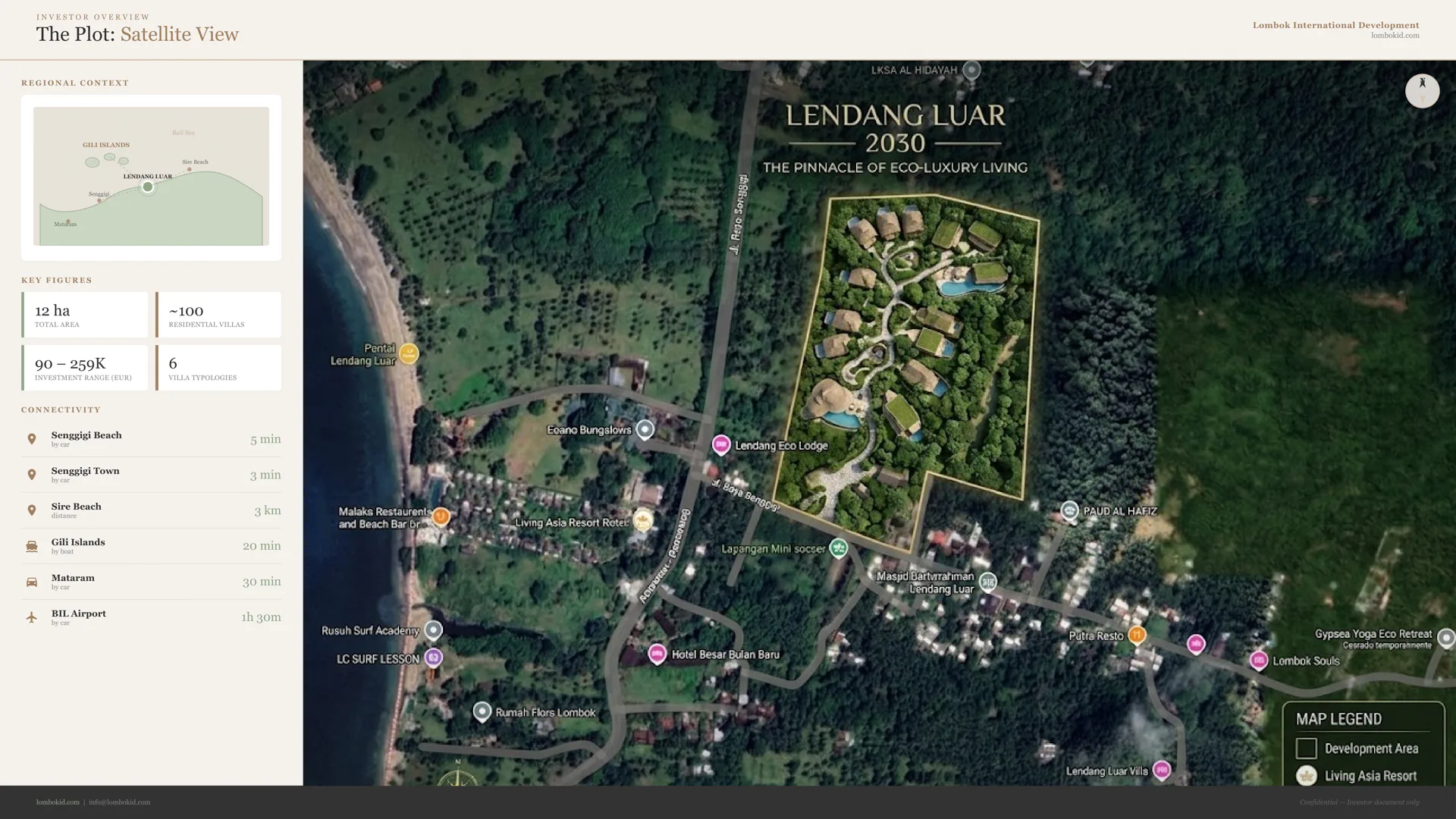
The financial models we use for our Lombok developments do not assume the MotoGP peak as structural profitability: they incorporate it as a load test that validates the market can absorb premium ADR over a specific week. The construction schedule of the first phase of Lendang Luar 2030 plans staggered deliveries that avoid October as a critical closing month, precisely so that operational villas are fully available during the event from the first fiscal year.
The location in the west of the island, at a reasonable distance from the circuit via the Mandalika road network, captures event demand without paying the location premium adjacent to the circuit, which carries trade-offs (traffic saturation, noise, elevated land prices) that weigh during the other 360 days of the year.
Frequently Asked Questions
Is buying a Lombok villa with MotoGP in mind a sound thesis?
Not as the primary thesis. MotoGP is one catalyst among several (air expansion, hotel pipeline, cleaner regulation than Bali, price-per-square-meter differential) that support the Lombok thesis as an emerging market. Turning the Grand Prix into the central argument distorts the decision: the event contributes between 4% and 7% to annual gross income, not half the return.
What happens if MotoGP eventually leaves Mandalika?
It is a real risk, not a remote hypothesis. Dorna's contract with Indonesia has a revision date and circuits compete each cycle for inclusion in the calendar. If Mandalika lost the round, the event-week ADR effect would disappear, but the rest of the thesis (air infrastructure, SEZ, hotel pipeline, demand from Australia/Singapore/KL) would hold. The structural yield's sensitivity to the event is on the order of 0.5%-1.2% annually.
Does demand around the event stay only in Mandalika or spread across the island?
It spreads with a gradient. Mandalika absorbs 100% of its capacity; Kuta and Senggigi fill at 70-90% depending on proximity and category; the Gilis and the north (Tanjung) capture demand through stay extension and complementary experience. A villa in the west-northwest zone participates in the effect without paying the immediate-proximity premium to the circuit.
How does it compare with similar events in Bali?
Bali does not host an international sporting event with the media reach and temporal concentration of MotoGP. Its demand is more distributed throughout the year, which generates more volume but less ability to capture concentrated peak rates. For a premium villa, Lombok's anchor-event-plus-base-season model is operationally more profitable per night within the correct window.
Risks and Caveats
Any investor weighing MotoGP as an input in their financial model should consider:
- Calendar risk: Mandalika's inclusion in the World Championship is renegotiated by cycles. Losing the round would eliminate the annual October pulse and force a revision of the seasonal occupancy curve. Financial models should contemplate a loss-of-event scenario between year five and year ten as part of sensitivity analysis
- Operational saturation risk: concentrating events on the same air and hotel infrastructure can degrade the guest experience (delayed flights, service under pressure) and erode the villa's reputation on review-based platforms
- Climate risk: October closes the dry season but the transition can bring rain or winds that affect the event. A weather cancellation leaves the villa with the opportunity cost of premium rates locked in without alternative bookings
- Supply risk: if Mandalika accelerates the opening of five-star rooms beyond demand growth, the effect on premium villas could be rate compression in the event window
- Currency risk: income is collected in rupiah and the European investor evaluates returns in euros. A rupiah depreciation in October may absorb part of the event's nominal gain, as already observed in May 2026
What to Read Next
- Lombok-Australia Direct: Why the New Air Route Matters for Your Investment: analysis of the Darwin-Lombok air corridor and routes pending during 2026
- Lombok rental yield analysis 2026: ADR, occupancy, and net yield by typology in local currency
- Lombok 2026: The Infrastructure Boom Behind the Investment Case: integrated pipeline of airport, Mandalika SEZ, and hotel projects
Sources Consulted
- Dorna Sports / motogp.com, "MotoGP 2026 Calendar: Indonesia Round" (May 2026)
- VOI, "MotoGP 2026 Complete Schedule, Mandalika Held October 9-11" (May 2026)
- The Jakarta Post, "Mandalika MotoGP draws record crowd, $289m economic boost" (6 October 2025)
- Jakarta Globe, "MotoGP Mandalika 2025 Breaks Records, Drives Rp 4.8 Trillion Boost for NTB Economy" (October 2025)
- ANTARA News, "Indonesian MotoGP drives major economic boost, tourism surge: official" (October 2025)
- VOI, "SEZ Mandalika Records Economic Turnover Of IDR 4.8 Trillion During MotoGP 2025"
- VOI, "Ahead Of MotoGP 2025, Hotel Occupancy In Mandalika Is Almost 50 Percent" (September 2025)
- Reef Property Lombok, "2025 Lombok Property Market in Review" (2024 ADR/occupancy data)
- ITDC / Kementerian Pariwisata, communications on the Mandalika SEZ hotel pipeline
- Marina Bay City, "Mandalika SEZ Lombok: MotoGP, Infrastructure & Growth"
Lombok International Development is a developer specialized in villas and integrated projects in Lombok, Indonesia. We operate under a PT PMA structure with full regulatory compliance. For a specific conversation on investment strategy and anchor-event modeling, contact us.
CONTINUE READING
Related Articles
Lombok-Australia Direct: Why the New Air Route Matters for Your Investment
TransNusa opens the first direct Darwin-Lombok flight in February 2026. Perth, Kuala Lumpur, and Singapore follow. Analysis of what expanded air connectivity means for yields, occupancy, and the investor market.
Lombok 2026: The Infrastructure Boom Behind the Investment Case
USD 3 billion in government infrastructure, MotoGP, airport expansion, and 25% tourism growth. Why Lombok's investment window is driven by concrete catalysts, not speculation.
Lombok's 2026 Connectivity Reset: What the Fast Boat, the Bypass and New Flights Mean for Your Villa's Occupancy
Three access vectors unlock at once in Lombok in 2026: the Sanur-Mandalika fast boat pier, the 17.3 km airport bypass, and denser Bali-Lombok flight frequency. What that says about demand, and what it does not guarantee for a villa's occupancy.
INVESTOR DOSSIER
Want the full picture on Lombok?
Receive the investor dossier with current pricing, legal structure and a five-year projection tailored to your profile.